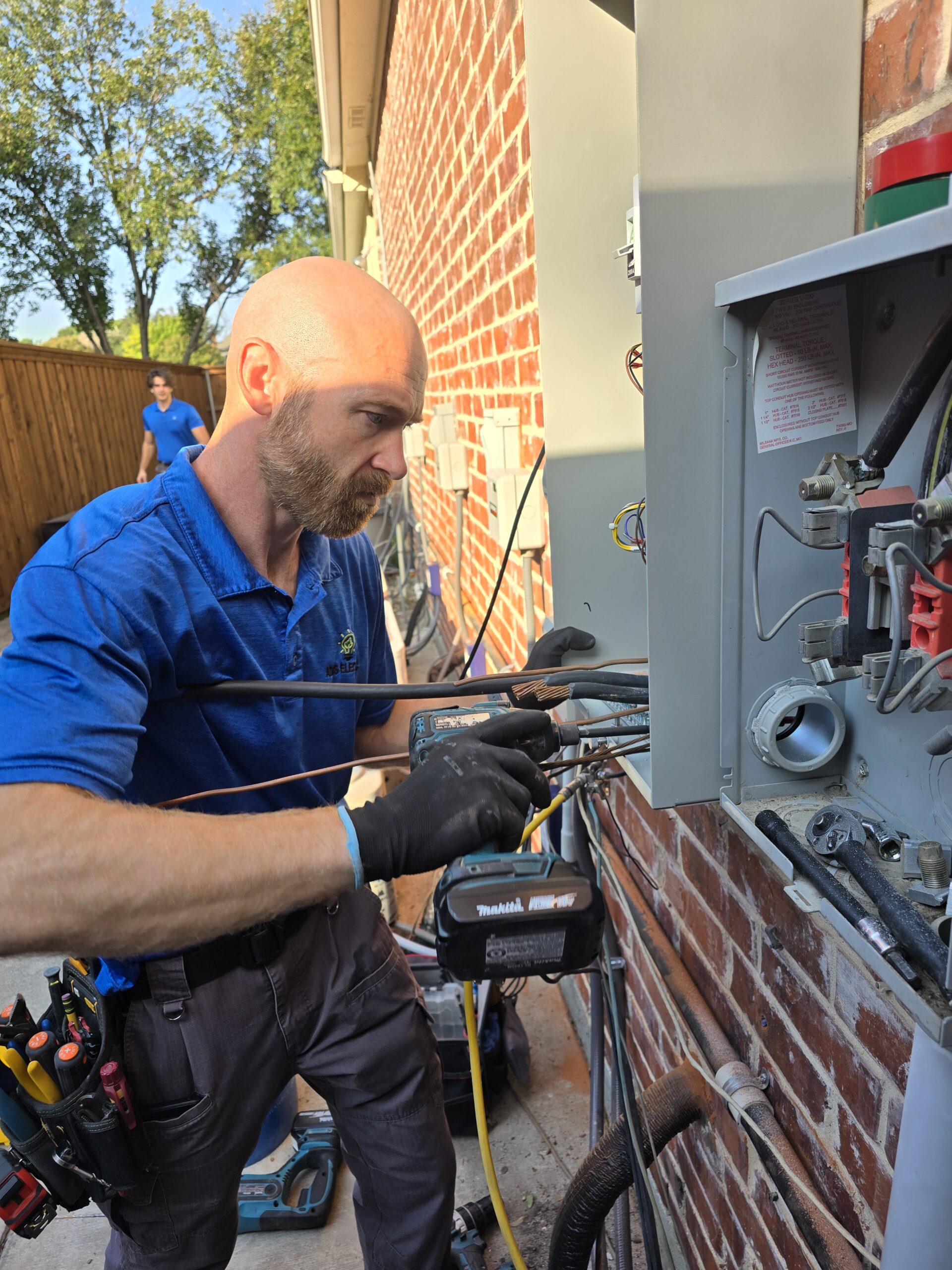
Signs Your Frisco Electrical Panel Cannot Handle Your Summer AC Load
Published by Adis Electric
July 7, 2026
Most homes do not really outgrow their wiring, they outgrow their service, the total amount of power the panel can hand out at one time. That gap shows up hardest in summer, which is when an electrical panel upgrade in Frisco, Texas, turns from a someday project into the actual reason the air conditioning keeps knocking out the lights. The wiring in the walls is often fine. The box feeding it is the bottleneck. Spotting that early is what keeps a routine, planned upgrade from turning into an after-hours scramble. A panel usually drops several hints before it gives out, and they are easy to read once you know which ones count.
1. Capacity Is the Whole Question
The number that matters most is stamped right on the main breaker, usually 100, 150, or 200 amps. That figure caps how much the entire house can draw at any single moment, no matter how many circuits branch off of it. Plenty of homes were wired back when cooling was lighter and kitchens, garages, and home offices asked far less of the system. Once a modern air conditioner runs at the same time as everything else, a smaller service can sit pinned hard against its ceiling. At that point, the panel is not faulty; it has simply run out of room left to give. A useful rule of thumb is that the continuous load on a service should stay under roughly 80 percent of its rating, so a 100-amp panel really has far less working capacity than the headline number suggests.
2. What a Maxed-Out Panel Shows You
A service pushed to its edge rarely stays quiet about it for long. The most common overloaded electrical panel symptoms are a main breaker that drops out on the hottest days, interior lights that sag or flicker the second the compressor engages, and metal on the panel that feels warm rather than cool. Add a low hum, a sharp plastic smell, or browning around a breaker, and heat is clearly building somewhere it should not. A box with every slot already filled, or two wires doubled onto a single breaker in what electricians call a double tap, says the same thing in a slightly different way. Replacing the same breaker again and again, only for the fresh one to keep tripping, points squarely at the load instead of the part.
3. The Cooling System’s Heavy Pull
Cooling equipment earns the most scrutiny because nothing else in the house competes with its appetite. A typical central system draws steadily while it runs and then spikes hard for a moment at every startup, when the compressor demands a burst far above its normal pull. When that pattern of the AC drawing too much power meets a panel with no slack left, the surge alone can dim a room or knock the main offline. Worn parts only make it worse, since a weak capacitor, low refrigerant, or a dust-fouled coil forces the motor to grind harder for the very same cooling. That brief dip you notice in the lights is the panel straining to feed the compressor’s inrush while the fridge, the lights, and everything else stay on.
4. Problems That Cannot Wait
A slow capacity squeeze can usually wait for a scheduled visit, but certain warnings absolutely cannot. A panel that is hot through its cover, throwing sparks, smelling of scorched plastic, or showing a melted breaker is a local emergency, and the safe move is to kill the affected circuits and step well back. Those symptoms mean current is arcing across a bad connection, which is exactly how fires begin behind the drywall. A main that keeps dropping and refuses to hold sits in the same bracket, since it is the last line of protection the whole system has. Once a panel reaches that state, speed matters far more than convenience, and resetting into it only raises the risk.
5. Why Doubling the Service Fixes It
Stepping a home up from 100 amps to 200 roughly doubles what the house can safely pull at once. That breathing room lets the air conditioning cycle freely without robbing the rest of the home, while leaving capacity for a car charger, a spa, or a remodel somewhere down the road. The job usually renews the meter base, the main breaker, the grounding and bonding, and any aging or recalled panel brand that insurers no longer want to cover. In a tighter home, a properly sized subpanel can sometimes add the needed circuits without a full service change. A permit and an inspection come with it, which is the right level of oversight for the equipment feeding your entire house. The result clears the summer tripping at its root, rather than papering over it with one more reset.
A panel that buckles under a summer cooling load is telling you something plainly, the household now pulls more power than the service was ever built to hand out. Swapping a single breaker rarely settles it, since the real answer is fitting the panel and service to how the home runs in the present, not how it ran twenty years ago. Adis Kikic has been making exactly that call through Adis Electric for nearly thirty years, fully licensed and insured, with every crew member’s background checked and a photo of the team sent ahead so you always know who is arriving. He keeps digging until the true cause surfaces, then corrects it for good. When the heat keeps beating your panel, his experience is the steady hand worth calling.
“Lights dipping and the main dropping every hot day? Your service may be tapped out. Call Adis Electric at 214-613-1000 for a load assessment and upgrade.”
FAQs
Q1: How do I know if my electrical panel is too small for my AC in Frisco, Texas?
In Frisco, Texas, watch for a main breaker that trips on hot days, lights that dim when the AC starts, a warm panel, and no spare slots. Since continuous load should stay near 80 percent of the panel’s rating, a strong AC startup can push a small service over, which usually means it is undersized.
Q2: How much does it cost to upgrade an electrical panel in Frisco, Texas?
For homeowners in Frisco, Texas, it depends on the new service size, whether the meter base and grounding need replacing, and permit and inspection fees. A 100 to 200 amp upgrade is the common move. A licensed electrician should assess your real load and provide a written quote before starting.
Q3: Why do my lights dim when the AC turns on in Frisco, Texas?
Around Frisco, Texas, brief dimming when the AC starts is the panel straining to feed the compressor’s inrush surge. Occasional flicker can be normal, but frequent or deep sags often mean an overloaded service, a loose connection, or an undersized panel, all of which an electrician should inspect.